
Organizations love projects.
A new program. A new curriculum. A conference. A training initiative. A technology platform. A restructuring. A strategic plan.
Projects are tangible.
They have names, budgets, timelines, meetings and launch dates. They give us something we can point to and say:
This is whatwe are doing.
And projects can be enormously valuable.
But they are rarely the thing that creates lasting change.
When good programs aren't enough
Imagine a community with significant social challenges.
Unemployment. Addiction. Homelessness. Educational gaps. Mental health needs.
Now imagine that the community already has organizations addressing almost all of them.
There is a rehabilitation program.
There are educational services.
There is workforce training.
There are shelters.
There are psychological services.
There are charities providing food, clothing and other forms of support.
At first glance, the obvious conclusion might be that the community has a strong network of services.
Except it doesn't.
It has a collection of services.That's different.
Each organization works hard within its area. Each has its own staff, expertise, funding, resources and objectives.
But the person needing help doesn't arrive as a collection of separate problems.
The same person may need education, employment, housing, counseling and addiction support.
And when the organizations aren't connected, something predictable begins to happen.
Each organization tries to solve more of the problem itself.
The rehabilitation program starts addressing employment.
The employment program starts dealing with housing.
The shelter begins providing counseling.
Organizations stretch beyond their expertise because the people they serve need more than their particular program can provide.
Eventually, resources become diluted.
The organizations aren't failing because they don't care.
They aren't failing because they lack expertise.
And they may not even be failing because there aren't enough resources.
Adding more isn't always the answer
When organizations encounter a problem, one of the most common responses is to add something.
Another program.
Another position.
Another committee.
Another training.
Another technology.
Another initiative.
Sometimes that's exactly what's needed.
But sometimes the organization already possesses most of the pieces required to solve the problem.
They're simply disconnected.
A school might have excellent teachers, counselors, extracurricular programs, learning support and technology—and still struggle to create a coherent student experience.
A company might have talented people, strong departments, sophisticated systems and significant resources—and still struggle with execution.
A community might have dozens of organizations doing excellent work—and still fail to produce meaningful development.
The instinct is often:
What arewe missing?
A better question may be:
That question changes the problem.
And therefore changes the solution.
From programs to systems
Suppose the community organizations described earlier stopped trying to become everything for everyone.
Instead, each organization continued doing what it did best.
Rehabilitation remained excellent at rehabilitation.
Workforce organizations remained excellent at employment development.
Educational organizations focused on education.
Counselors provided counseling.
Housing organizations focused on housing.
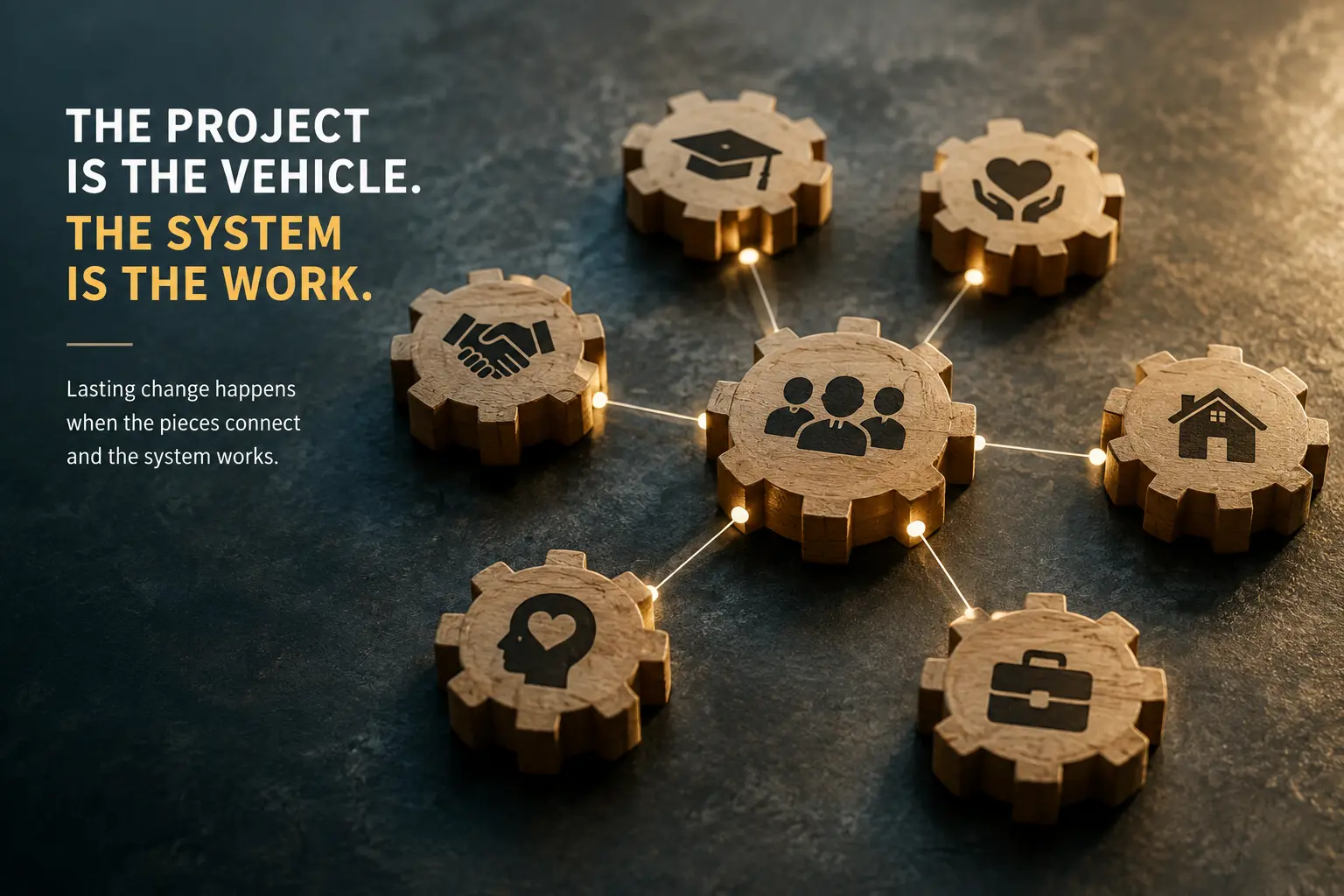
But now those organizations were connected.
A person entering through any one organization could access the expertise of the entire network.
Development could be coordinated.
Progress could be followed.
Information could move appropriately between providers.
Resources could be shared.
Organizations could refer people confidently rather than trying to reproduce services themselves.
Suddenly, the community hasn't necessarily gained another program.
It has gained something potentially much more valuable.
It has gaineda system.
The pieces existed before.
The change came from the architecture between them.
This happens inside organizations too
The same principle applies at almost every scale.
Schools introduce new curricula without redesigning assessment, teacher development or scheduling around them.
Companies conduct leadership training while leaving incentives that reward the opposite behavior.
Organizations introduce new technology while maintaining workflows designed for the old technology.
Communities create initiatives that duplicate services already operating a few streets away.
Then, when the initiative fails to produce the expected result, we conclude that the project didn't work.
Maybe.
A project can introduce an idea.
It can create momentum.
It can bring people together.
It can demonstrate what's possible.
It can even produce impressive short-term results.
But if everything around the project continues operating exactly as before, the existing system will usually win.
Eventually, the conference ends.
The training is forgotten.
The new initiative becomes another old initiative.
And the organization starts looking for the next project.
Design what happens next
This is why one of the most important questions in development isn't:
What should we create?
It's:
What needs to exist around thisso that it continues working?
- Who owns it?
- What behaviors support it?
- What behaviors undermine it?
- How does information move?
- Where are decisions made?
- What happens when something goes wrong?
- How do people know whether it's working?
- What existing resources can support it?
- What incentives reinforce it?
- What happens when the person who started it leaves?
Those questions aren't as exciting as launching something new.
But they determine whether the launch matters.
Because sustainable change doesn't happen simply because we introduce something better.
It happens when the environment around that better solution begins reinforcing it.
Make it inevitable
Projects matter.
We need them.
They give ideas form. They create opportunities to experiment. They allow people to experience something different.
But the project should never be mistaken for the outcome.
- A conference isn't collaboration.
- A curriculum isn't learning.
- A training session isn't development.
- A strategic plan isn't strategy.
- A new organizational structure isn't culture.
Those things are vehicles.
The real work is building the relationships, habits, incentives, structures and feedback loops that allow the desired outcome to continue after the project ends.
Sometimes that means creating something new.
But often it means looking differently at what is already there.
Connecting pieces that were operating independently.
Removing barriers that were working against one another.
Creating an environment in which the better behavior becomes the easier, more natural and eventually expected behavior.
The project gets people's attention.
The system determines what happens next.
And when the system begins reinforcing the outcome you want, change no longer depends on continually pushing people toward it.
It starts pulling them there.
That is when change becomes inevitable.