
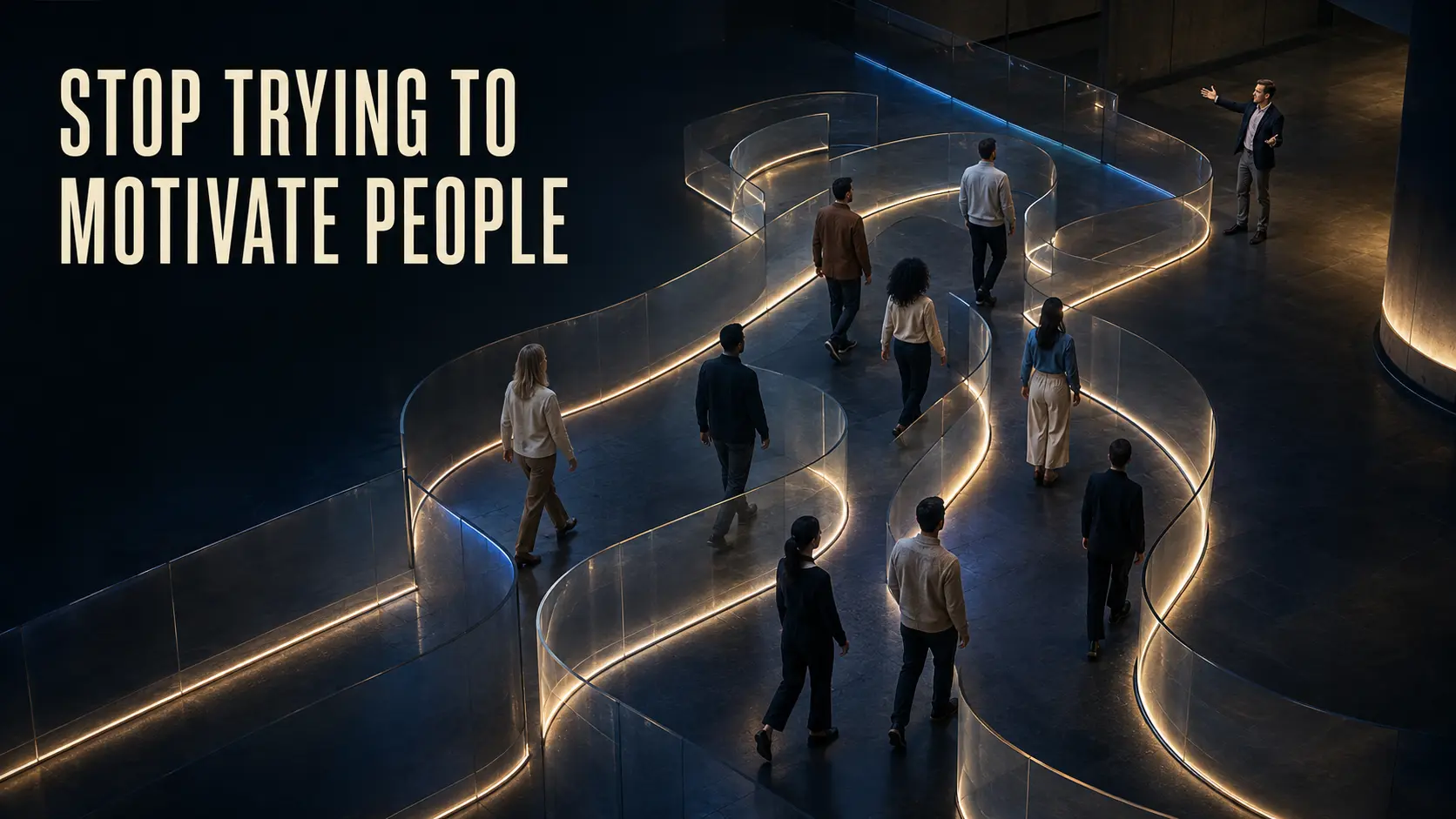
Organizations spend a remarkable amount of time trying to motivate people.
Schools try to motivate students to learn and teachers to improve. Businesses try to motivate employees to take initiative. Coaches try to motivate athletes to work harder. Community organizations try to motivate people to participate.
When the desired behaviour does not appear, motivation becomes the diagnosis:
They just don'tcare enough.
Sometimes that is true.
But before blaming the people, we should look more carefully at the environment we have placed around them.
What we accept
Imagine an organization that says it wants innovation.
It tells people to experiment, challenge assumptions and develop new ideas. But when an experiment fails, the person responsible is criticized. When someone questions an established practice, they are labelled difficult. When a new idea creates additional work, it is quietly pushed aside.
Eventually, people stop experimenting.
The organization may conclude that its people lack initiative. But they have actually learned exactly what the environment taught them:
Consider a school that says it wants students to become independent learners. Yet teachers make every meaningful decision, provide every instruction and solve every difficulty before students have time to struggle.
The students become dependent.
Then adults complain that they lack independence.
Or consider a sports program that says character matters, but gives the most playing time, attention and status to the most talented athletes—regardless of their effort, discipline or treatment of others.
The athletes learn the real lesson:
In each case, the stated message and the lived experience are different.
The posters say one thing.
The environment teaches another.
And the environment usually wins.
People adapt to what surrounds them
People are not simply responding to what leaders say. They are responding to what their environment repeatedly rewards, discourages, permits and makes possible.
If taking initiative consistently creates more work without greater influence, people learn not to volunteer.
If asking for help is treated as weakness, people learn to hide problems.
If every mistake is punished, people learn to avoid difficult challenges.
If development is discussed but never given time, people understand that development is not actually the priority.
These are not necessarily signs of lazy, resistant or unmotivated people. They are often rational adaptations to the environment.
This is why motivational speeches rarely create lasting change.
A speech may produce a moment of energy. A workshop may generate insight. A new slogan may briefly focus attention. But people eventually return to the same routines, expectations and consequences that shaped their behaviour in the first place.
Change does not happen simply because people understand something differently.
It happens when they begin doing something differently—and continue doing it often enough for a new habit to take hold.
If the environment keeps pulling them back toward the old behaviour, enthusiasm will eventually lose.
What could be
Instead of asking, “How do we motivate people?”, imagine asking:
What is our environmentcurrently teaching people to do?
That question changes the conversation.
We stop beginning with what is wrong with the people and start examining the conditions surrounding them.
If we want teachers to collaborate, have we created time and structures for meaningful collaboration—or merely added meetings to already crowded schedules?
If we want employees to take initiative, do they have the authority to act—or only permission to make suggestions?
If we want athletes to demonstrate character, is character consistently coached, recognized and rewarded—or only mentioned when someone behaves badly?
If we want students to think independently, are they regularly expected to make decisions, attempt difficult problems and recover from mistakes?
Motivation still matters. People are not machines, and no environment can guarantee that every individual will respond in the same way.
But good environments make the desired behaviour more natural, more valuable and more likely to be repeated.
They make improvement easier to begin and harder to abandon.
What makes it inevitable
To make a behaviour inevitable, we cannot merely announce it as a goal. We have to build it into people's repeated experience.
That means aligning at least four things:
- Expectations: Do people clearly understand what the desired behaviour looks like in practice?
- Opportunity: Does the environment give them regular chances to practise it?
- Response: What happens when they try, struggle, make mistakes or succeed?
- Repetition: Is the behaviour reinforced consistently enough to become a habit?
A school cannot develop independent learners without allowing students to experience independence.
A company cannot develop initiative while requiring approval for every meaningful action.
A team cannot develop resilience if athletes are protected from every difficult moment.
An organization cannot build trust while its systems communicate suspicion.
The outcome we want must be present in the experience we repeatedly create.
This is where many change efforts fail. We introduce a new idea but leave the old environment untouched. We train people in collaboration and return them to isolated roles. We teach creative thinking and continue rewarding only correct answers. We promote leadership and retain systems in which nobody is trusted to lead.
Then we wonder why nothing changes.
The problem was not necessarily the idea.
The environment simply made the old behaviour more inevitable than the new one.
Begin with a better question
The next time you feel frustrated by someone's lack of motivation, pause before trying to inspire, pressure or persuade them.
Look at the environment.
What behaviour is it rewarding?
What risk is it teaching people to avoid?
What is it making unnecessarily difficult?
What has it allowed people to practise until it became normal?
You may discover that the people are already motivated.
They have simply become motivated to survive the system we created.